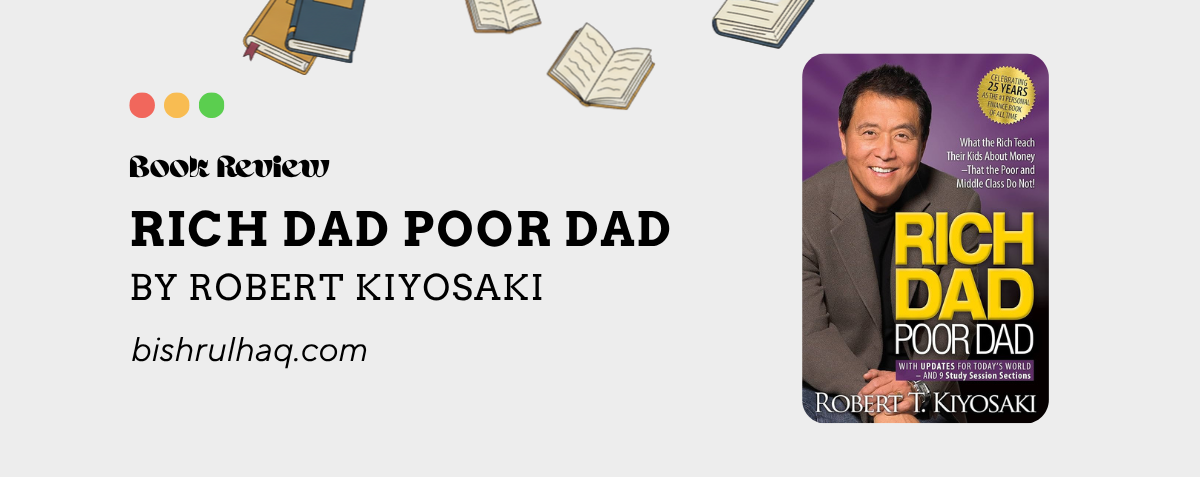
This is one of those books that everyone in your life will mention at some point. Your uncle at a wedding. A coworker during a quiet lunch. A random LinkedIn post from someone you used to go to school with. I resisted reading it for years out of pure stubbornness, Then one weekend, during a long journey, I finally gave in.
The premise, in one paragraph
Kiyosaki grew up in Hawaii with two father figures. His biological dad was a well-educated government employee, respected in the community, who struggled with money his entire life. His best friend's dad was a businessman without a college degree who became wealthy through small businesses and real estate. The book is a series of lessons that the rich dad taught the author about money, and a running critique of the advice his actual dad gave him. It is part memoir, part manifesto, and part sales pitch for a very specific worldview about wealth.
What I actually got out of it
Strip away the anecdotes and the branding and there are really two big ideas in this book that did something to my brain.
The first is the asset versus liability reframe. Kiyosaki's definition is blunt and deliberately simple. An asset puts money into your pocket. A liability takes money out. That is the whole definition. No accounting subtlety, no depreciation schedules, just in or out. Under this definition, the house you live in is a liability, not an asset, because it costs you every month and produces nothing back. This is probably the most-argued-with line in the book, and I think for most readers it is also the most useful. It forces you to look at what you own and ask, honestly, which side of that equation each thing is actually on.
The second big idea is the difference between working for money and making money work for you. Nothing about that sentence is new. Kiyosaki didn't invent the concept of passive income. But he drives the point home by describing friend after friend of his, all high-earning professionals with impressive titles, who were one paycheck away from broke because every dollar they earned came from selling their time. I watched a friend of mine live through exactly this situation last year. It was painful and it was textbook, and I found myself mentally quoting Kiyosaki while she explained it to me over coffee.
What I would not hand to anyone
The specific investing advice. Kiyosaki talks confidently about real estate deals, tax strategies, and "finding opportunities" in a way that worked for his specific time, place, and network, and some of it reads as either outdated or, honestly, a little reckless to anyone reading it in the current decade. I would not use this book as a guide to what to actually do with your money. I would use it as a reset for how you think about your money.
He also carries a strange contempt for formal education throughout the book that starts to grate after about chapter three. You can make the point that school doesn't teach financial literacy without also implying that teachers are fools and that anyone with a degree is trapped. The first version of that argument is fair. The second version is just bitterness dressed up as wisdom, and the book would have been better without it.
The cash flow diagram
There is a diagram early in the book showing how money moves through the financial lives of different income classes. The poor spend everything they earn. The middle class buy liabilities they think are assets, like bigger houses and nicer cars. The rich buy real assets and use the cash flow from those assets to buy more. That single diagram, if you actually understand it rather than just nodding at it, is worth more than most of the personal finance carousels you will scroll past this month. I would save it, screenshot it, print it on a sticky note, whatever it takes to make it stick.
The thing I like about the diagram is that it makes an abstract idea physical. Most people think about their money in terms of income only. How much am I making this month. Am I making more than last year. The diagram forces you to think instead about direction and velocity. Where is the money going after it lands in your account, and how quickly. Once you start seeing money that way, a lot of the debates about lifestyle and budgeting feel silly.
Who should read this book
If you have never seriously thought about where your money goes every month and you need something that will shake you out of autopilot, read this. It works as a wake-up call, and wake-up calls are underrated. Most people will never sit down and audit their own spending. If a book can get you to do that, it has earned its price.
If you already track your expenses, know what an index fund is, have some savings set aside, and understand the basics of compound interest, this book has almost nothing to offer you. Read The Psychology of Money instead. I reviewed that one separately, and it is the more honest and the more useful of the two.