There is a point in almost every conversation about purpose where someone mentions ikigai. Usually with a diagram.
Four overlapping circles showing what you love, what you are good at, what the world needs, and what you can be paid for, with a small sweet spot in the middle that is supposed to be the answer to everything. I had seen that diagram a hundred times before I finally read the book it supposedly comes from, and I was curious whether the rest of the material held up to the viral image.
Short answer: the book is gentler, slower, and stranger than the diagram suggests, and I liked it more because of that.
What the book actually is
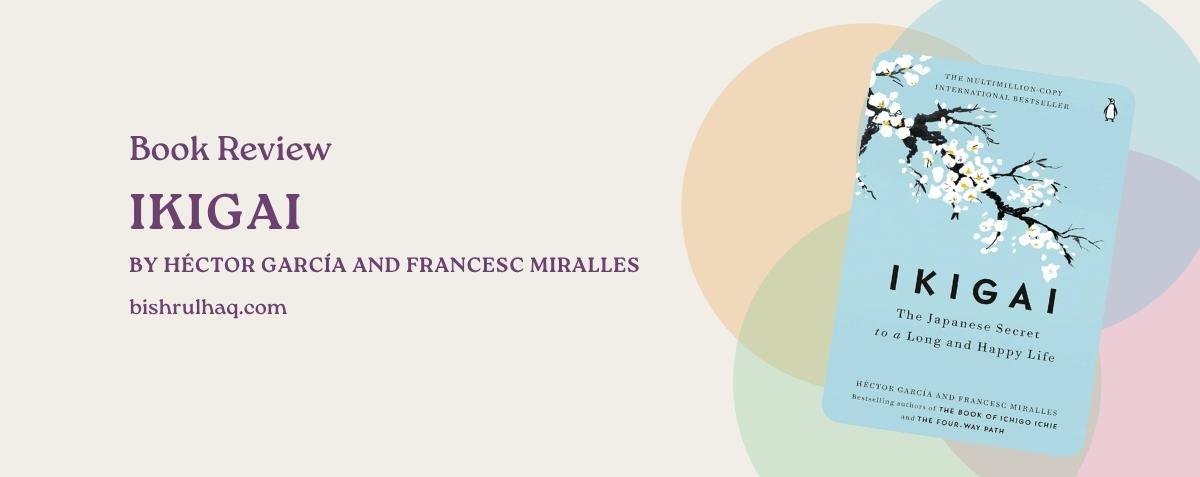
Héctor García and Francesc Miralles are two Spanish writers who spent time in Okinawa interviewing residents of Ogimi, a village famous for its unusually high number of centenarians. The book is part travelogue, part interview compilation, part light philosophy, and part collection of habits and practices from people who lived past a hundred and still seemed cheerful about it. It is short, which is the first thing in its favour. Most books in this category would have been padded out to twice the length.
The authors are honest about the fact that they are outsiders writing about a place they visited. They are not trying to pass themselves off as Okinawan elders. They are two foreigners who were let in to a particular corner of the world, took careful notes, and tried to bring back what they thought would travel. The book works best when you read it with that understanding. It is an outsider's notebook, not a sacred text, and you can trust the observations more when you remember that.
The four-circle diagram, in context
The four-circle diagram shows up early in the book, and the authors are honest about the fact that it is a Western adaptation of the Japanese concept rather than a strict translation. In the interviews with older Okinawans, nobody actually uses the four-circle framing. They talk about purpose in much quieter language. The thing that gets them out of bed in the morning. The work they do with their hands. The community they show up for. The meal they cook. The garden they tend.
That was my first real takeaway from this book. The viral version of ikigai makes it sound like a problem you can solve on a whiteboard in an afternoon. The village version is smaller and slower. It is less about finding some grand intersection of your talents and more about maintaining a few daily commitments that keep you gently tied to the world. Nobody in Ogimi seems to have agonised about finding their life's purpose. They simply kept doing what they had always done, and called that a life.
The habits that keep coming up
A lot of the book is given over to observing what the centenarians in Ogimi actually do with their time. A handful of patterns appear again and again.
- They never fully retire. Most of them have some small work or craft they continue into their nineties.
- They eat until they are about eighty percent full, a practice known locally as hara hachi bu.
- They walk every day, usually as part of daily errands rather than as deliberate exercise.
- They belong to a moai, a small group of friends committed to supporting each other financially and emotionally for life.
- They spend real time outdoors, usually in a garden, and they do not rush it.
None of this is breaking news. You have read these points before. What the book does well is show how these habits interlock in one specific place, rather than presenting them as a list of tricks. In Ogimi, the walking is connected to the neighbours, which is connected to the moai, which is connected to the purpose, which is connected to the eating. It is a system, not a checklist, and the system is what keeps it running for a lifetime rather than for six weeks.
The flow chapter that earns its place
The middle of the book pivots into a chapter on Mihaly Csikszentmihalyi's research on flow, which at first felt like a detour. The more I thought about it, the more the chapter earned its place. The authors argue that one of the reasons the elders in Ogimi are content is that they are still performing skilled work into their eighties and nineties, and skilled work naturally produces flow states. They weave. They carve. They plant. They mend.
They are still learning, still adjusting, still getting slightly better at something that matters to them. Most modern retirees, by contrast, are dumped out of their careers into a structureless stretch of afternoons and expected to be happy about it. The book is gentle about this, but the critique is real, and it stayed with me long after I put the book down.
Where the book thins out
The later chapters wander. There are sections on resilience, on Japanese gymnastic practices like radio taiso and tai chi, and a chapter on Viktor Frankl and logotherapy that feels slightly out of place. Individually, the chapters are fine. Together, they start to feel like the authors found a good opening and a good closing and stitched whatever else they had between them.
I did not mind this too much, because the book is short enough that even the weaker chapters are over quickly. But if you come in expecting a tightly argued thesis, you will be mildly frustrated. This is not that kind of book. It is a cup of tea disguised as a self-help title, and a cup of tea is fine when that is what you needed.
The line that stayed with me
"Only staying active will make you want to live a hundred years."
That is attributed to one of the Ogimi residents, and it keeps popping into my head at odd moments, usually when I am sitting on the couch not wanting to get up. There is something clarifying about the word "want" in that sentence. The book is not arguing that activity will keep you alive. It is arguing that activity is what gives you a reason to want to keep being alive, which is a different and much more interesting claim.
Who should read this
- People who have seen the ikigai diagram a hundred times and want the calmer, less commercial version of the idea.
- Anyone who is approaching a career change and needs a gentler frame than the usual productivity books offer.
- Readers who enjoy travel writing as much as they enjoy self-help, because half the book is really about a village.
- Anyone who has older family members and is quietly worried about what a good later life looks like, because the book is really about that more than it is about anything else.
If you want a rigorous study of longevity, read something else. If you want a peaceful hour or two with a book that quietly suggests you might be overcomplicating your life, this one is worth the time. I keep it on the same shelf as a few other small books I reach for when the week has been too loud.