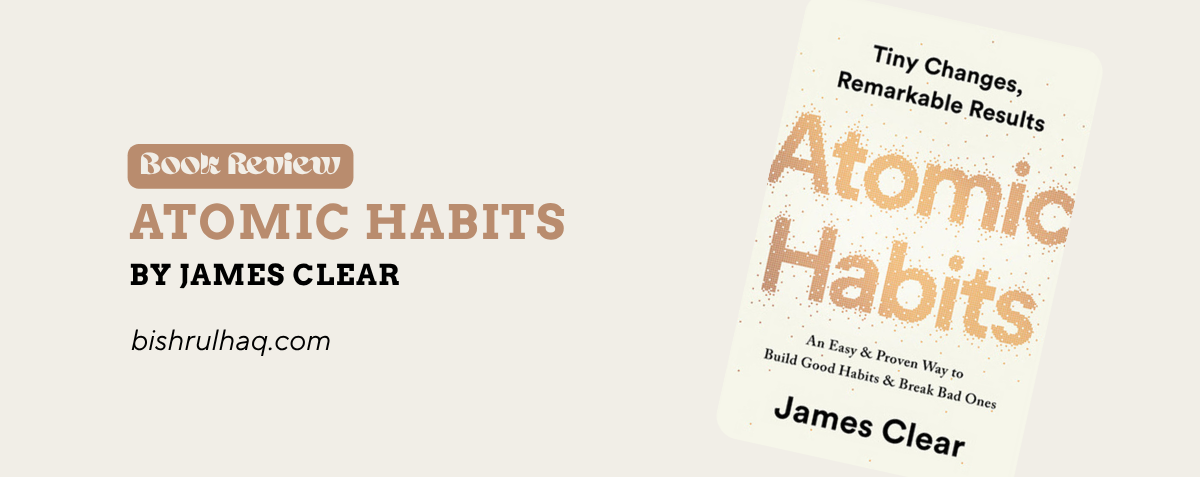
Atomic Habits is the book your coworker will quote at you during a one-on-one. It is the book your gym friend mentions when you complain about falling off a routine. It is the book that appears in the "top read this year" section of every productivity podcast. At this point, sitting down to review it feels faintly silly, like reviewing bread, or water, or daylight.
I read it first in 2023, and again a couple of months ago. The two reads gave me different things, and that second pass is the one I want to write about.
What Clear actually argues
The core idea of the book is this. You do not rise to the level of your goals. You fall to the level of your systems. Big, ambitious goals do not, on their own, get anyone anywhere. What actually changes a life is the small, boring, repeatable things you do every day whether you feel like it or not. Clear breaks this down into four "laws" of habit formation. Make it obvious, make it attractive, make it easy, make it satisfying. Under each law, he gives you practical tactics you can actually try tomorrow morning, which is more than most productivity books bother to do.
What actually stuck for me
On the first read, I came away with a general sense that I should build better habits, and then I went right back to my normal life without changing much of anything. On the second read, three things locked in properly.
The first is habit stacking. The pattern is simple. "After I do X, I will do Y." You attach a new habit to an existing one and use the existing habit as the cue. I now use this for flossing, for stretching after I brush my teeth, and for writing morning pages after I pour my first coffee. It is the single most useful tactic in the whole book and it is almost stupid in its simplicity. The power of it is that it removes the question of when, which is usually what kills new habits before they have a chance to take root.
The second is the two-minute rule. When you are starting a new habit, shrink it until the first version takes two minutes or less. Don't "go to the gym." Put on your gym clothes. Don't "write the book." Open the document and type one sentence. The point is to lower the activation energy of starting so far that skipping would be ridiculous. I used this to break a six-month writing block last year. I told myself every day, "you only have to open the file." Most days I wrote more than one sentence once the file was open, because opening the file turned out to be the hard part.
The third is identity-based habits. Instead of saying "I want to run a marathon," say "I am a runner." It sounds like a cheap self-help reframe until you actually try it, and then it is weirdly, surprisingly effective. Every action you take starts to function as a small vote for the kind of person you are becoming. Missing a day does not feel like missing a day on a plan. It feels like casting a vote against the person you are trying to be, and that is much harder to ignore than a broken streak.
The one part I think is a little oversold
The "1% better every day" framing. You know the chart. The one that shows compounding at 1.01 over 365 days and ends at 37.78. It is a great visual and it makes for a great quote. It is also slightly misleading, because real improvement does not compound that cleanly, and nobody actually measures themselves improving by a clean, measurable one percent every single day at anything real. I think Clear uses it as an inspirational hook rather than as a literal formula, but I have heard people quote it as if it were a law of physics.
The underlying point, that small improvements add up over time, is obviously true. You do not need a compound interest equation to believe it. I wish the book had trusted its reader a little more and skipped the chart entirely.
What Clear does that most authors in this genre don't
He cites his sources. He admits when the research is mixed. He keeps his chapters genuinely short. He doesn't pad the book with endless personal anecdotes about his own heroism. Comparing this book to most of the productivity shelf is like comparing a well-written technical doc to a corporate blog post. It is clean, it is respectful of your time, and it assumes you are not an idiot, which is already more than most books in this space are willing to do for you.
Who should read this
Honestly, most people who haven't already. It is the best entry-level book I know on behaviour change, full stop. If you have read it before, my suggestion is to read it again. The chapters you glossed over the first time are almost certainly the ones you needed, and a year of real life between the two reads will teach you what you missed the first time around.