
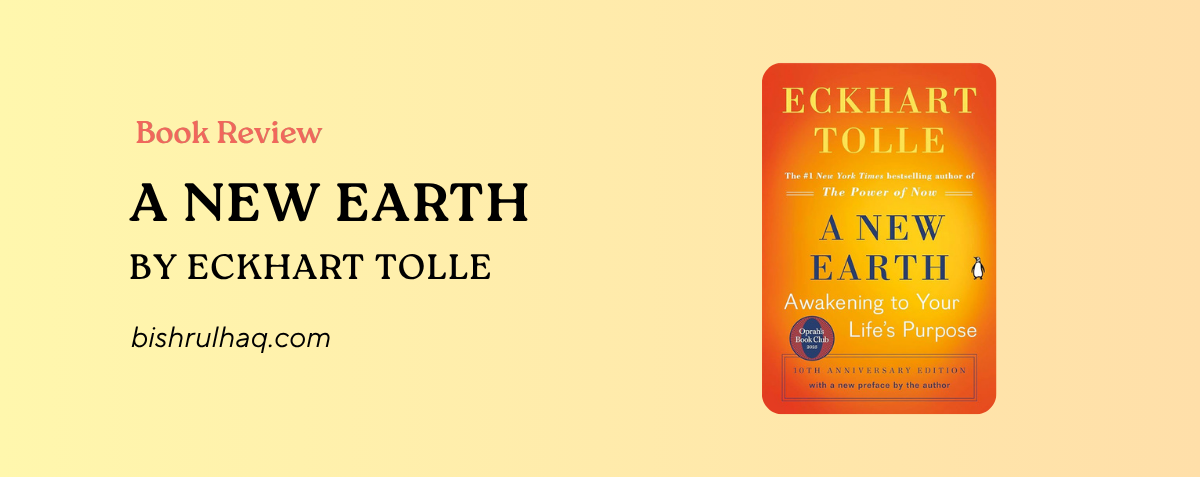
The Power of Now was a gift from a friend years ago. I read it once, felt like I understood about sixty percent of it, and put it back on the shelf. A New Earth is Eckhart Tolle's follow-up, and for years people kept telling me it was "the better one" and "the one that really lands." So I finally sat down with it a few months ago.
It is not the easier one. I want to say that upfront, so nobody comes at it expecting a light afternoon read.
What the book is actually about
If The Power of Now was about the idea of presence, A New Earth is about the thing that prevents presence. That thing is the ego. Tolle spends most of the book explaining how the ego works, how it feeds on drama and conflict, why your sense of "me" is mostly a collection of mental habits rather than a solid, continuous thing, and what life starts to look like when you gradually stop identifying with it. The book is arranged less like a tutorial and more like a long essay in chapters, each one circling the same theme from a slightly different angle.
The central concept that most people remember from this book is the "pain body." Tolle uses this term for the accumulated emotional pain from your past that lives inside you and occasionally wakes up and takes over your nervous system. When someone cuts you off in traffic and you have a reaction that is completely out of proportion to what just happened, that is the pain body wanting to feed on a new situation. Once he describes this pattern, you start noticing it everywhere, in yourself and in the people around you, and that is both the best and the most unsettling thing about the book.
Why chapter three almost lost me
Tolle writes in a very particular voice. It is calm, patient, unhurried, and extremely sure of itself. At its best, reading him feels like talking to someone wise who has seen a lot and is not in a rush to prove anything. At its worst, it feels like being monologued at by someone who has never once in their life used the word "maybe." Chapter three contains a long stretch about how our names, roles, and possessions are all illusions, and I remember sitting on my sofa thinking, yes, fine, but I still have to pay rent under this illusion, and my landlord does not accept enlightenment as legal tender.
What pulled me back into the book was the chapter on the pain body, which is still the one I think about most often. Whatever you feel about Tolle's spiritual vocabulary, the observation underneath that concept is real, and it is practical in a way that surprised me. I have actually used it in the middle of an argument, caught myself mid-reaction, and recognised that I was about to do something that had very little to do with the actual conversation in front of me.
The parts I will actually use
There are a few ideas from this book that made it into my daily life and stayed there. The first is the practice of watching the thinker. You notice a thought happening inside your head without identifying with it. This sounds like nothing on paper. In practice, in the middle of a two-in-the-morning spiral, it is the difference between spending an hour catastrophising and spending five minutes. It is worth learning for that reason alone.
The second is Tolle's distinction between a situation and the story you are telling yourself about the situation. Something happens. That is the situation. Everything else you add to it, every interpretation, every assumption about what it means, is the story. I have caught myself stacking twelve layers of meaning onto events that were, objectively, just things that happened, and almost every time, the real weight of the experience was in the layers rather than the event.
The third, and the one I least enjoyed learning, is the observation that the ego often prefers being right over being happy. I do not love this about myself. It is true anyway. Tolle forces you to see it, and once you see it clearly, you cannot quite unsee it, which is the sign of an honest book even when the honesty is uncomfortable.
The parts I skimmed
There is a lot of cosmic language in the final third of the book. Talk about the "flowering of consciousness" and humanity's next evolutionary leap and a new stage of collective awakening. I genuinely do not know how to evaluate claims like that, and I am not going to pretend I do. I took what was useful for me in daily life and let the rest pass by without arguing with it. Your mileage may vary depending on how allergic you are to that register of writing.'
Who should read this
Anyone who has read The Power of Now and feels ready for the longer, denser, more difficult version of the same conversation. If you have not read that one first, start there. A New Earth assumes you already have some tolerance for Tolle's way of talking, and if you have not built that tolerance up yet, this book will feel like wading through treacle. Start with the shorter, earlier one and come back if it lands for you.

.png)